
How to Find Your Blind Spots (Before They Cost You)
You cannot find your blind spots by looking harder. Here are 6 methods to start today, each with clear steps and a worked example.
A blind spot is not something you are bad at. It is something about you that you cannot see. Other people often see it plainly. You walk past it every day.
This guide answers one question: how to find yours. You will not find it by thinking harder. You find it by gathering facts from places your mind cannot edit, then looking for what repeats.
Below are 6 methods. Each one has steps you can start today and a short worked example. You do not need all of them. Pick two, run them for a week, then compare what they show you.
Two other guides cover the questions around this one. If you want to know why a pattern keeps coming back, read why you keep repeating the same patterns. If you want the common blind spot types in detail, read the 5 blind spot patterns that run your life.
Why Looking Harder Does Not Work
Your mind keeps a story about who you are. It lets in the facts that fit the story and quietly drops the rest. So when you sit down and ask yourself what your blind spots are, you get the story back.
That is why every method below has the same shape. You collect facts from outside your own head: other people, your past results, your calendar, and your own words written down on the day. Then you look for the thing that shows up more than once.
6 Ways to Find Your Blind Spots
Which pattern runs your life?
Before you start looking, find out which pattern shapes your choices. 10 statements, about 60 seconds, free.
Take the Free Blind Spot Test1. Ask Three People One Question
Other people see your patterns from the outside. Most of them will not tell you unless you ask. The trick is to make an honest answer easy to give.
- Pick three people from different parts of your life. One from work, one from family, one friend.
- Send each of them this message: “I am trying to see myself more clearly. What is one thing I do again and again that I might not notice? I will not argue. I will just say thank you.”
- When they answer, reply “Thank you” and nothing else. Do not explain or defend.
- Write down their exact words, not your summary of them.
- Look for overlap. If two of the three say something close, treat it as real.
Worked example
Maya asked her manager, her sister and an old friend. Her manager said she takes on work no one asked her to do. Her sister said she never asks for help. Two of the three answers pointed the same way: Maya carries everything alone. She had always called that being reliable.
Expect some answers to miss. Each person sees you through their own history with you. One answer is a clue. Two that match are a lead.
2. Audit Your Repeated Outcomes
Your plans show who you want to be. Your results show how you actually act. For this method, look only at results.
- Write down 5 times in the last few years when something ended badly in a way that felt familiar. A job you left, a fight that went the usual way, a goal you dropped.
- For each one, write three short lines: what happened just before, what you did, and how it ended.
- Cross out anything another person did. Keep only your own actions.
- Circle any action that shows up in three or more of the five. That is your lead.
Worked example
James listed two jobs he quit, a business partner he split from, and two friendships that faded. Once he crossed out what the other people did, one line kept showing up: he stopped talking and started planning his exit. He had blamed each ending on the other person. The common thread was how he met the first sign of conflict.
3. Keep a One-Week Defense Log
How fast you defend yourself is a clue. When feedback lands on a blind spot, you start explaining before the other person has finished. Feedback that misses barely stings.
- For seven days, keep a note open on your phone.
- Each time you feel the urge to explain, justify or push back, write two or three words about the topic. Do this even when you were right.
- At the end of the week, group the notes by topic.
- The topic with the most notes is the one to look at closely.
Worked example
Priya's log had 14 notes. Nine were about time: being late, a slow reply, a deadline that slipped. She argued hardest when someone said she looked overloaded. The blind spot was not lateness. It was saying yes to more than fits in a day.
4. Check Your Calendar Against What You Say Matters
Most people can name what matters most to them. Your calendar and your spending show what you actually chose. The gap between the two is often a blind spot.
- Write down the three things you say matter most to you right now.
- Open your calendar for the last two weeks. Next to each item, note how many hours you gave it.
- Do the same with your spending for the last month.
- Find the item with the biggest gap between what you say and what you did. Then look at what got that time instead.
Worked example
Tom said his top three were his kids, his health and his writing. In two weeks, his writing got zero hours. Work email after 9 p.m. got eleven. He did not lack time. He was using work to avoid starting something he might fail at.
5. Take a Structured Test
A good test gives you words for something you have only half sensed. Once you can name a pattern, you start to catch it while it is happening.
The Blind Spot Test is free and takes about 60 seconds. You rate 10 statements. It tells you which of 5 patterns is most active in your life: the Deflector, the Intellectualizer, the Overachiever, the People Pleaser or the Controller.
- Take the test when you are calm, not right after a fight.
- Rate what you actually do, not what you wish you did.
- Read your result next to your notes from methods 1 to 4. Look for the place where they agree.
Worked example
Maya, from method 1, took the test. Her result was the People Pleaser. It matched what her sister said about never asking for help. A test on its own is a guess. A test that matches what two people told you is evidence.
6. Keep a Short Daily Record and Read It Back
The methods above are snapshots. A daily record shows you the whole arc. Most blind spots only become clear across weeks, because any single day looks reasonable on its own.
- Each evening, write one line for each of two prompts: what did I avoid today, and where did I react faster than I meant to?
- Do not reread your notes during the week.
- On the seventh day, read all seven days in one sitting. Mark any word or situation that shows up three or more times.
Worked example
After seven days, Dana's notes said some form of 'I will deal with it later' nine times. Each time, the thing she put off was a hard talk with someone. The tasks were never the hard part. The talks were.
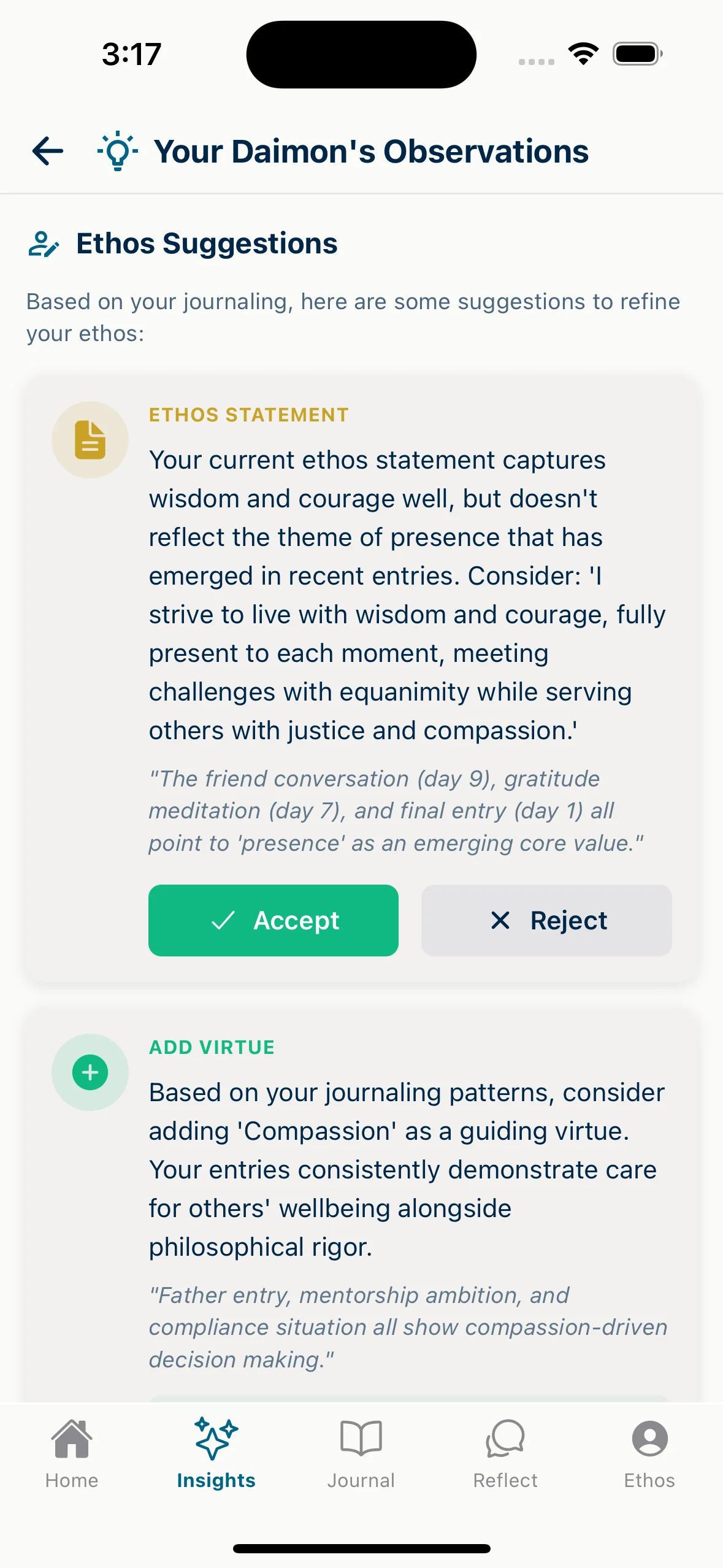
Paper works for this. So does an app built for it. The Stoics wrote about the daimon, an inner voice that sees you clearly even when you do not. Know Your Ethos is built on that idea. Its daily check-in is a deck of 5 short cards that takes about 2 minutes.
The app's Daimon is a mirror. It reads your answers over time and shows you the patterns in them. It does not tell you what to do. It shows you what is there.

How to Tell a Real Blind Spot From a Bad Week
Not every clue is a blind spot. Before you act on one, check it against these four signs.
- It shows up in more than one part of your life, such as work and home.
- Two or more sources point to it: a person, a test, your notes or your calendar.
- You feel a quick urge to defend it when someone names it.
- It has been true for months, not just since a hard week.
If a clue meets two or more of these, treat it as real and keep watching it. If it meets none, let it go. Save your attention for the clues that hold up.
A 7-Day Plan to Find Your Blind Spots
- Day 1: Send the message from method 1. Start your defense log and your two nightly lines.
- Day 2: Take the Blind Spot Test.
- Day 3: Write your 5 repeated outcomes and circle what repeats.
- Day 5: Check your calendar and spending against what you say matters.
- Day 7: Read everything together: the replies, the log, the test result and your notes. Finish one sentence: “The pattern I keep missing is ...”
One honest sentence is the goal for this week. You are not trying to fix anything yet.
What to Do Once You See It
Finding a blind spot is not the same as changing it. For the first few weeks, just notice when it shows up. The Stoics called this prosoche, which means attention. You cannot act differently until you can see what you do now.
When you are ready to work on it, the steps for breaking a pattern are in why you keep repeating the same patterns.
Take the free Blind Spot Test to put a name on your pattern today. It is 10 statements and takes about 60 seconds.
Find the Pattern Running Your Life
10 statements. About 60 seconds. See which pattern shapes your choices.
Take the Blind Spot TestRelated reading: Why You Keep Repeating the Same Patterns (And How to Stop) | What is a Daimon in Philosophy? | Introduction to Stoicism