
Why You Keep Repeating the Same Patterns (And How to Stop)
You are not broken. You are running a pattern you cannot see. Here is why your brain keeps producing the same results and what actually works to break the cycle.
You said you would never date someone like that again. Then you did. You said you would stop overcommitting at work. Then you did. You said this time would be different. It was not.
This is not a willpower problem. It is not a discipline problem. It is a pattern problem, and patterns are invisible to the person running them.
Why Patterns Repeat
Your brain builds patterns to keep you safe. When you were younger, your brain noticed what worked (getting approval, avoiding conflict, staying busy, keeping control) and turned those behaviors into defaults. These defaults ran so long that they stopped feeling like choices. They started feeling like personality.
“That is just who I am” is almost always a pattern talking.
The problem is not the pattern itself. Every pattern served a purpose at some point. The problem is that your brain does not update its defaults when the situation changes. The thing that protected you at 12 still runs your behavior at 35, even when it no longer fits.
Here is what that looks like:
The relationship pattern.
You keep choosing the same type of partner. Not because you have "a type," but because your brain steers you toward dynamics that feel familiar. Familiar feels safe, even when familiar means painful.
The conflict pattern.
You either avoid conflict entirely or escalate it every time. Not because you choose to. Because your brain learned one strategy for dealing with tension and never built a second one.
The work pattern.
You overcommit, burn out, recover, and overcommit again. Not because you love being busy. Because your brain tied your self-worth to productivity, and rest feels like evidence that you are not enough.
The approval pattern.
You shape yourself around what others want. Not because you are generous. Because your brain learned early that love was conditional, and the safest move was to make sure everyone else was comfortable first.
The 3 Reasons You Cannot See Your Own Patterns
1. The Pattern Feels Like You
When you have been doing something your whole life, it does not look like a behavior. It looks like identity. “I am a people pleaser” is not a statement of fact. It is a pattern that has been running so long you forgot it was installed.
This is the most important thing to understand. You cannot change something you experience as fixed. As long as the pattern feels like “who you are,” you will keep running it.
2. Your Brain Explains It Away
Every time the pattern produces a bad result, your brain finds an external explanation. It was the other person's fault. The timing was bad. You were stressed. The company was toxic.
Some of those explanations might even be true. The pattern is not the explanation. The pattern is that you keep ending up in situations where you need the explanation.
3. You Only See the Moment, Not the Arc
Inside a single situation, your behavior makes sense. Of course you avoided that conversation. Of course you said yes to that project. Of course you chose that person.
It is only when you zoom out and look at the last 10 conversations, the last 5 projects, the last 3 relationships that the pattern becomes visible. Most people never zoom out. They live moment to moment and wonder why the moments keep rhyming.
Which pattern runs your life?
Before you can break a pattern, you need to name it. 10 statements, 60 seconds, no email required.
Take the Free Blind Spot TestWhat Actually Works to Break a Pattern
Step 1: Name It
You cannot work with what you cannot name. The first step is giving the pattern a label. Not a clinical label. A personal one.
“I avoid saying what I actually need” is better than “I have anxious attachment.” The more specific and honest the name, the more you will recognize it in real time.
The Blind Spot Test identifies which of 5 avoidance patterns is most active in your life. 10 statements, 60 seconds. It gives you a name for the thing you have been vaguely sensing but never articulated.
Step 2: Watch It Without Trying to Fix It
This is counterintuitive. Most people want to jump straight to changing the behavior. That does not work because the pattern is faster than your conscious mind. By the time you notice it, you are already in it.
Instead, just watch. The Stoics called this prosoche, careful attention. When the pattern activates, notice it. Notice how your body feels. Notice what triggered it. Notice what story your brain tells to justify it.
You are not trying to stop it. You are trying to see it. Seeing clearly comes before acting differently.
Step 3: Map the Trigger
Every pattern has a trigger. Something happens (usually an emotion, not an event) and the pattern fires automatically.
Common triggers:
- Feeling like you are not enough (triggers overachieving, people pleasing)
- Feeling out of control (triggers controlling, micromanaging)
- Feeling vulnerable (triggers deflecting, intellectualizing)
- Feeling unseen (triggers performing, withdrawing)
Find the feeling underneath the behavior. That is the trigger.
Step 4: Build a Record
This is where journaling matters, but not the way most people do it. Writing “I had a good day” every night does not surface patterns. You need a record that accumulates over time and lets you (or something) look for threads across entries.
Voice journaling works well for this because you are more honest when you speak than when you type. You say things out loud that you would edit on paper.
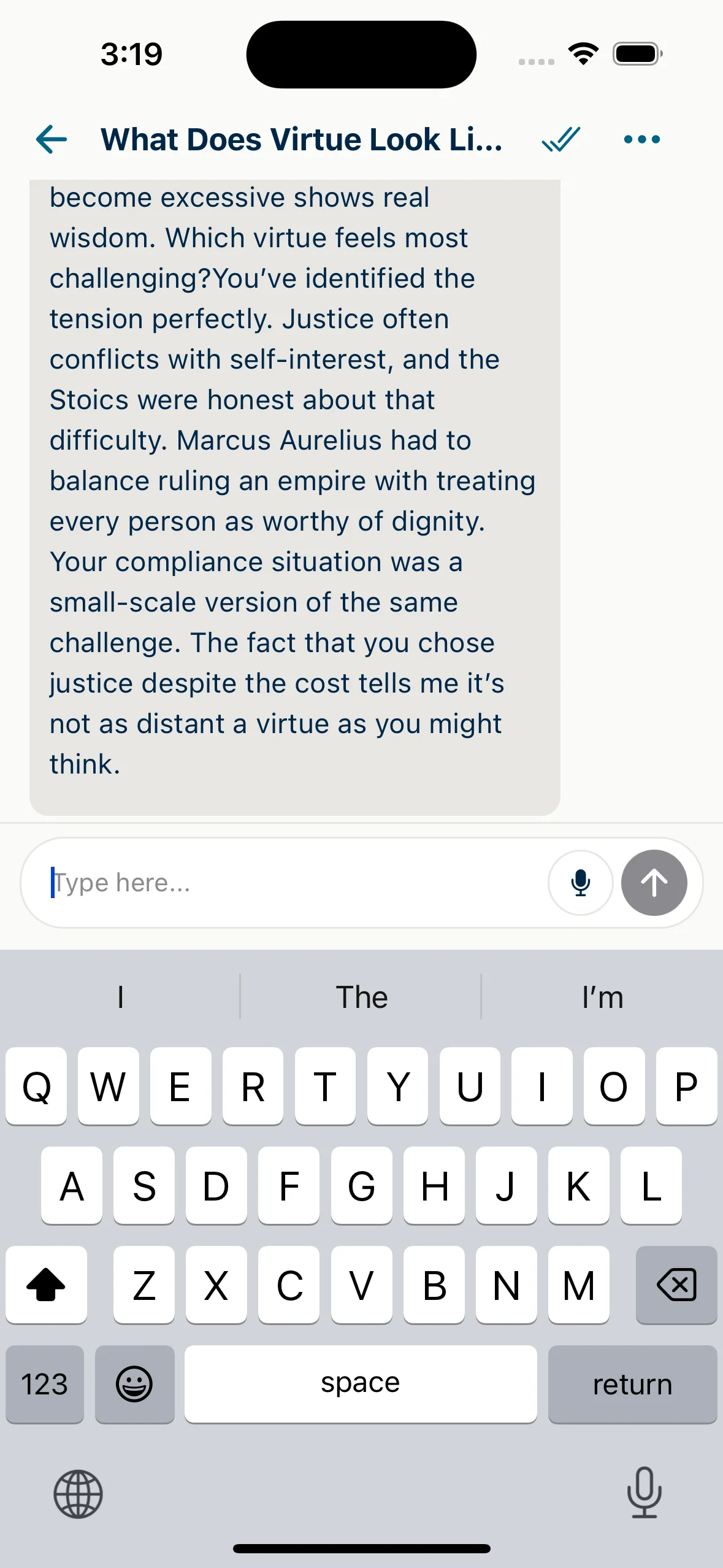
Know Your Ethos is built specifically for this. You speak into the app, the AI transcribes and analyzes across entries, and over time it shows you the patterns you cannot see from inside a single moment. It is an AI mirror, not a therapist. It shows you what is there. What you do with it is up to you.

Step 5: Choose One Moment to Respond Differently
You do not break a pattern by overhauling your life. You break it by choosing one small moment to respond differently.
The next time the trigger fires and you feel the old default pulling you, do one thing differently. Say the thing you would normally swallow. Pause where you would normally react. Rest where you would normally push harder.
One moment. That is enough. The pattern took years to build. It breaks one conscious choice at a time.
The Stoic Perspective
Marcus Aurelius wrote in Meditations: “The things you think about determine the quality of your mind.” He was not talking about positive thinking. He was talking about seeing clearly.
The Stoics believed that most suffering comes not from events themselves, but from the stories we tell about them. Patterns are stories your brain tells on autopilot. They fire before you think. They shape what you see, what you feel, and what you do, all without your permission.
The Stoic solution is not to fight the pattern. It is to see it. To watch it fire and, in that moment of awareness, choose whether to follow it or not. That gap between the trigger and the response is where freedom lives.
Start Here
Take the free Blind Spot Test to find out which avoidance pattern is running your life. 12 statements, 60 seconds, no email required. It will not fix the pattern. It will name it. That is where change starts.
Find the Pattern Running Your Life
10 statements. 60 seconds. No email required. See which avoidance pattern shapes your decisions, relationships, and habits.
Take the Blind Spot TestRelated reading: How to Find Your Blind Spots (Before They Cost You) | What is a Personal Ethos? | Introduction to Stoicism