
Best Dream Journal Apps in 2026 (More Than a Dream Diary)
The best dream journal app does more than store dreams. We compared 4 dream diary apps and dream journal software in 2026. Few go past a log.
Dream journaling has been around for a long time. Keep a notebook by your bed, write down what you remember when you wake up, look for themes over time. The method works. The execution is the problem.
Most people try it for a week, forget one morning, and never go back. Digital dream journal apps solve the consistency problem, but they introduce a new one: most of them are just note-taking apps with a moon icon.
We tested the dream journal apps available in 2026 to see which ones actually help you understand your dreams, not just store them.
Quick Comparison
| App | Best For | AI Analysis | Voice Input | Pricing | Platforms |
|---|---|---|---|---|---|
| Know Your Ethos | Dream patterns + life context | Yes (connects dreams to waking patterns) | Yes | Free / $9.99/mo | iOS, Android |
| Dreamapp | Dream interpretation community | Yes (symbol-based) | No | Free / ~$7/mo | iOS, Android |
| Lucidity | Lucid dreaming practice | No | No | Free / ~$5/mo | iOS, Android |
| Day One | Multimedia dream logging | No | Audio recording | Free / Premium | iOS, Android, Mac, Windows, Web |
Which pattern runs your life?
Before picking an app, find out what you actually need to work on. 10 statements, 60 seconds, no email required.
Take the Free Blind Spot TestWhy Most Dream Journal Apps Miss the Point
The standard dream journal app lets you write down your dream, tag it with symbols or emotions, and maybe shows you a calendar of how often you remembered your dreams. That is fine for tracking. It is not useful for understanding.
The interesting question about dreams is not “what did I dream about?” It is “why does this keep showing up?” Dreams repeat themes the same way waking life repeats patterns. The value of a dream journal is seeing those themes across time, not logging individual dreams.
Most apps treat each dream as a standalone entry. The best ones connect your dreams to each other and to your waking life.
1. Know Your Ethos
Dreams as Part of the Bigger Picture
Know Your Ethos includes dream journaling as one of 5 entry types alongside daily reflection, meditation, life events, and ambitions. The dream entries are voice-first: you wake up, talk into the app while the dream is still fresh, and the AI transcribes and analyzes it.

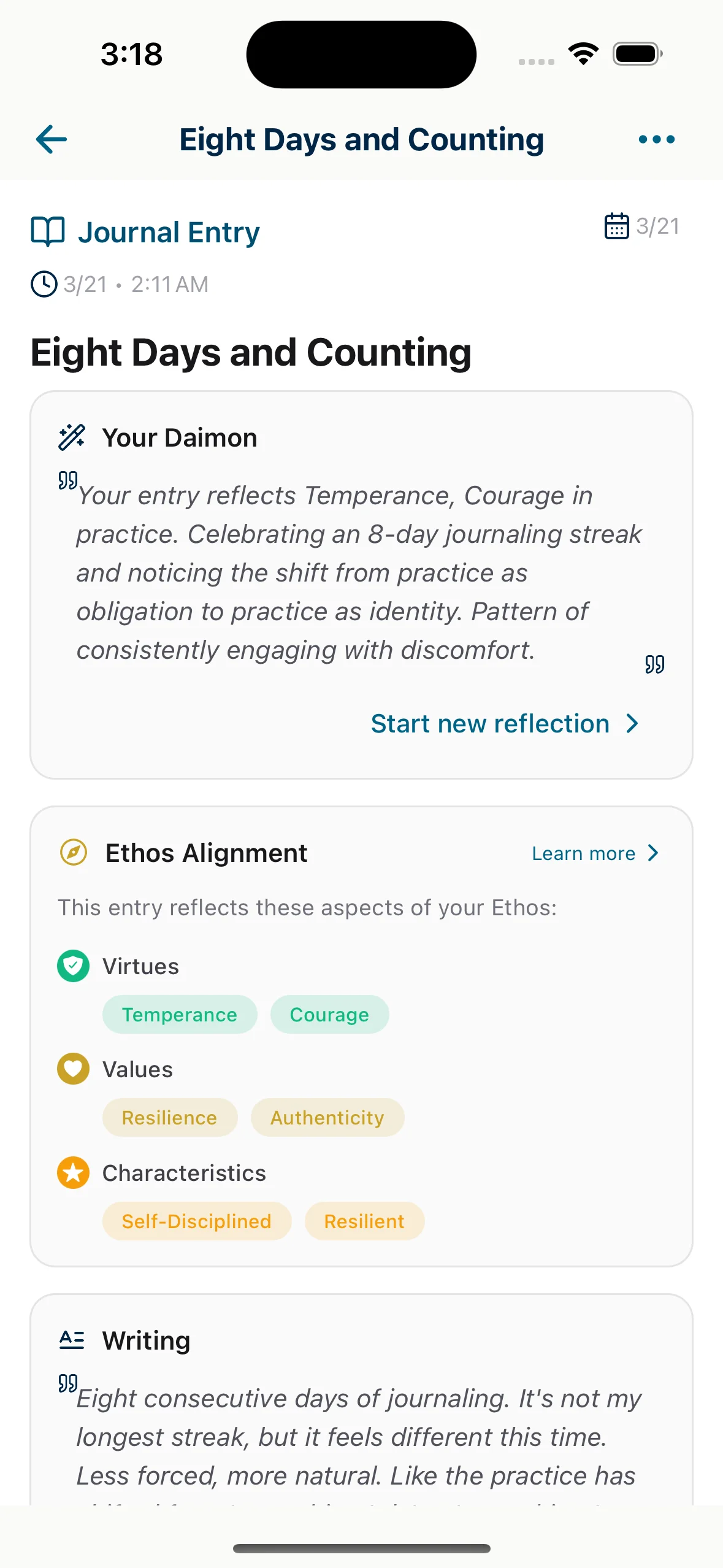
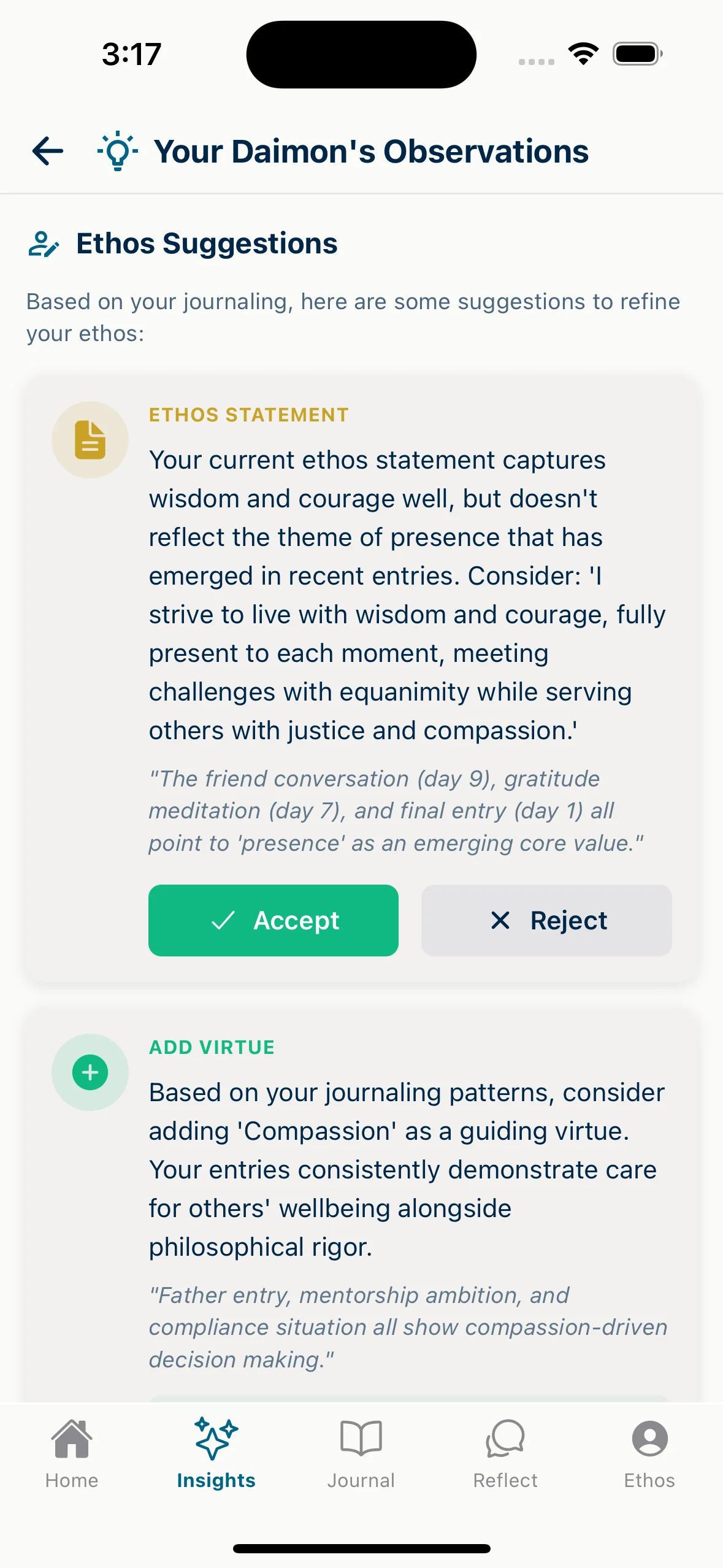
What it does well: KYE does not treat dreams as a separate category. It connects your dream entries to your other journal entries and looks for patterns across everything. If you keep dreaming about being unprepared, and your waking journal entries keep circling around impostor syndrome, the AI will surface that connection.
The Stoic framework matters here. The Stoics saw dreams as reflections of the soul's concerns, not prophecy, not random noise. The daimon (KYE's AI mirror) treats dreams the same way: as data about what your subconscious is working on.
Take the free Blind Spot Test to see if the approach fits you.
Limitations: Not a dedicated dream app. There is no dream symbol dictionary or lucid dreaming features. If you want dream-specific tools like reality check reminders or sleep stage tracking, look at a dedicated option.
2. Dreamapp
AI Dream Interpretation
Dreamapp is the most popular dedicated dream journal app. It uses AI to interpret your dreams based on symbol analysis, emotional context, and recurring themes. You type your dream, the AI gives you an interpretation, and over time it tracks your dream patterns.
What it does well: The interpretations are more thoughtful than you would expect. The AI considers the emotional context of your dream, not just the symbols. Dream tracking and statistics help you see how your dream life changes over time. The community features let you share dreams and see others' interpretations.
Limitations: Text-only input, which is a problem for dream journaling. Dreams fade fast. By the time you type out a detailed dream, you have already lost half of it. No voice input means you lose the immediacy that makes dream journals useful. The interpretations are symbol-heavy, which can feel like fortune-cookie psychology if you are skeptical of that approach.
3. Lucidity
For Lucid Dreaming Practice
Lucidity is built for people who want to lucid dream, not just record dreams. It includes reality check reminders, dream sign tracking, lucid dreaming techniques, and a journal to track your progress.
What it does well: If your goal is learning to lucid dream, Lucidity has the most complete feature set. Reality check notifications throughout the day, MILD and WBTB technique guides, and dream sign analysis help you build the awareness needed for lucid dreaming.
Limitations: Very narrow focus. If you are not interested in lucid dreaming specifically, most of the features are irrelevant. No AI interpretation, no voice input, no connection to your waking life patterns.
4. Day One
Traditional Journal with Audio
Day One is not a dream journal app, but it is worth mentioning because many people use it for that purpose. You can create a dedicated dream journal within Day One, record audio entries (helpful when you wake up and do not want to type), and attach photos or sketches of what you remember.
What it does well: The multimedia approach works well for dreams. Some people remember dreams visually and want to sketch them. Some remember them verbally and want to record audio. Day One supports both. Cross-platform sync means your dream log is available everywhere.
Limitations: No AI analysis of dreams. No dream-specific features like symbol tracking, interpretation, or pattern recognition. You are building a log, not gaining insights. Audio is recording only; it does not transcribe what you say.
The Honest Takeaway
Dream journaling works best when three things are true: you can capture the dream fast (before it fades), you do it consistently over weeks and months, and something (or someone) helps you see the patterns across entries.
Most dream journal apps solve problem one (digital capture) and partially solve problem two (reminders, streaks). Almost none solve problem three. That is where AI changes things.
Want dreams connected to your waking life patterns?
Know Your Ethos is the only app that analyzes dreams alongside your other journal entries. Take the free Blind Spot Test to start.
Want dedicated AI dream interpretation?
Dreamapp has the deepest dream-specific analysis.
Want to learn lucid dreaming?
Lucidity is built for that.
Want a flexible traditional journal you can customize?
Day One does everything, just without AI.
The best dream journal is the one you use the morning after. Everything else is a feature.
Find the Pattern Running Your Life
10 statements. 60 seconds. No email required. See which avoidance pattern shapes your decisions, relationships, and habits.
Take the Blind Spot TestRelated reading: How to Start Voice Journaling | Best AI Journaling Apps in 2026: 7 Tested. Most Are Alike. | What is a Daimon in Philosophy?